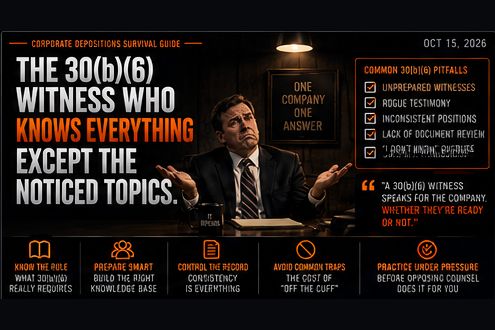
The problem hiding in plain sight
An executive’s institutional memory is not the organization’s prepared testimony. Rule 30(b)(6) requires a designee to speak to information known or reasonably available to the organization. The CEO who remembers the 2014 acquisition may have no idea how the company actually retains Slack messages. That is not a personality flaw. It is a preparation gap.
Where to look first
Start with the notice, not the witness. Create a matrix for each topic: custodians, responsive records, sources consulted, contested facts, and unanswered questions. If multiple designees will appear, map the boundaries of each assignment. The useful question is not whether the witness feels confident; it is whether the organization can show how the witness got informed.
The rehearsal that matters
In rehearsal, introduce an inconvenient document and ask how it fits the corporate position. Have the examiner jump between topics. Ask which facts come from personal memory and which come from an organizational investigation. Identify gaps and assign follow-up research rather than rehearsing a fictional certainty.
The rule and the practical limit
Rule 30(b)(6) includes a good-faith conference about examination matters. Scope objections and witness preparation are different tasks; neither replaces the other. A veteran executive can be a fine witness. The title on the business card does not do the homework.
A practical exercise for the next prep session
Before ending the meeting, have a second examiner ask five questions the witness has not seen. Include one inaccurate premise, one inconvenient document, one legitimate uncertainty, one follow-up that changes a fact, and one long silence. Record which answers require additional investigation. Correct the underlying preparation, not merely the wording of the answer.
What to take into the room
The goal is not to manufacture a perfect witness. It is to uncover uncertainty early, clarify what the evidence actually supports, and help a truthful witness remain accurate when questioning gets uncomfortable. Third Degree can support simulated questioning; attorney judgment and factual investigation remain essential.
The topic matrix is not optional
Make a separate row for each noticed topic. Identify custodians, document repositories, relevant time periods, people interviewed, organizational position, adverse evidence, and unresolved questions. The person who knows how the company operated in 2018 may have no idea what its retention policy was in 2024. A long tenure does not magically fill the gap. Rule 30(b)(6) concerns information known or reasonably available to the organization, not merely the designee’s personal memory.
A preparation drill you can actually run
Have a second lawyer begin with the least familiar topic, introduce an adverse document, jump to another topic, and then return to the first. Ask what sources support each answer. An unsupported but confident response is not an improvement over an honest limit. Record what must be investigated before the deposition. If the notice is ambiguous or overbroad, use the rule’s good-faith conference mechanism and appropriate procedural relief rather than hoping the witness will improvise.
What the opposing examiner will ask next
A prepared examiner rarely stops at the first answer. They ask how the witness knows, which record supports it, what contrary material exists, and whether the answer would change if a key premise proves false. Practice that sequence with the real file, not a hypothetical universe where every document supports your side. Identify the questions the team cannot yet answer and assign investigation before the testimony.
The distinction matters: rehearsal is a method for discovering weaknesses and helping a witness testify accurately. It is not an invitation to invent facts, conceal documents, or polish an unsupported story. Counsel should evaluate local rules, case orders, privilege, and the actual evidentiary record before applying any technique.
A 20-minute partner-level review
Give a lawyer who did not draft the outline twenty minutes with the file. Ask for the three most uncomfortable questions, the most damaging exhibit, and the one answer that would trigger follow-up discovery. Have that lawyer question the witness without warning. Then discuss where the witness relied on firsthand knowledge, reviewed records, or assumptions. Repeat after genuine factual gaps are addressed.
The final check is simple: can the witness explain what they know, how they know it, and what they do not know without pretending? That is a far more valuable outcome than an impressive practice score.
Field guide: The notice-to-answer audit
Suppose a notice seeks the company’s complaint-escalation practices from 2022 through 2024. The vice president remembers a ticketing queue. The system administrator remembers urgent complaints being handled by direct messages. The current policy was written in 2023. None of those facts alone answers what the company did throughout the noticed period. Make a topic matrix identifying custodians, records, relevant dates, conflicting evidence and remaining research. Then have a second examiner ask where each answer came from. The question “How do you know?” is a better preparation test than “Are you comfortable?”
Put it to work
Ask the witness to move between topics without warning. Introduce an adverse email, ask whether it changes the organizational position, then ask what the company searched to reach that position. Record missing information and investigate it. The 2020 Rule 30(b)(6) amendment requires a good-faith conference about examination matters; use it to clarify scope, not to pretend that the conference alone resolves disputes. A corporate designee need not know everything personally. The organization must prepare the designee on information reasonably available to it.
Legal source: Federal Rule of Civil Procedure 30 (Cornell LII)
Federal-law discussion is general; jurisdiction, local rules, and case orders may alter the analysis.
Protect Your Company from Binding 30(b)(6) Admissions.
A Rule 30(b)(6) designee's mistakes bind the entire corporation. Upload your noticed topics and case exhibits to our simulated Deposition Room and test your witnesses under intense adversarial questioning before they take the oath.
Supports case document uploads with OCR · Deception-risk tracking · Zero Data Retention guarantee