The problem hiding in plain sight
A transcript summary before lunch sounds great. So does avoiding a fight over where confidential testimony went. ABA Formal Opinion 512 addresses competence, confidentiality, supervision, communication, candor, and fees in lawyers’ use of generative AI.
Where to look first
Ask who operates the service, whether inputs and outputs are retained, whether content is used for training, which subprocessors receive it, who can access it, and what deletion means. Read the contractual terms and any protective order.
The rehearsal that matters
A public judicial opinion is not a sealed deposition. A lock icon is not a data-processing agreement. Verify privacy and zero-retention claims against current documentation rather than repeating product marketing.
The rule and the practical limit
The right moment for this diligence is before the upload. During a meet-and-confer about disclosure is an unnecessarily dramatic time to learn your vendor architecture.
A practical exercise for the next prep session
Before ending the meeting, have a second examiner ask five questions the witness has not seen. Include one inaccurate premise, one inconvenient document, one legitimate uncertainty, one follow-up that changes a fact, and one long silence. Record which answers require additional investigation. Correct the underlying preparation, not merely the wording of the answer.
What to take into the room
The goal is not to manufacture a perfect witness. It is to uncover uncertainty early, clarify what the evidence actually supports, and help a truthful witness remain accurate when questioning gets uncomfortable. Third Degree can support simulated questioning; attorney judgment and factual investigation remain essential.
The vendor questionnaire nobody wants to complete
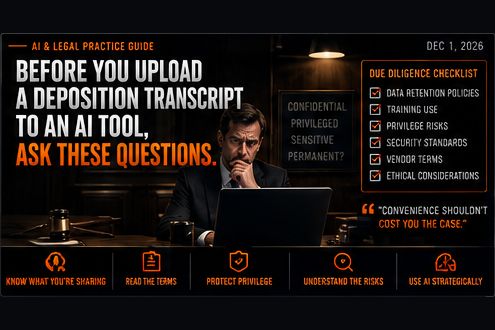
Before uploading a transcript or expert report to an AI system, identify what data leaves the firm, who can access it, whether it is used for model training, how long it is retained, whether subprocessors are involved, and how deletion is handled. Contract terms, technical configuration, and actual product behavior matter more than a homepage badge saying “secure.” Privilege and confidentiality are fact-specific; no tool can promise that every upload is legally harmless.
A preparation drill you can actually run
Try a practical tabletop exercise: a paralegal uploads a sealed exhibit, a partner requests deletion, and a client asks for the vendor’s retention terms. Can the team answer what happened, which account was used, and what copies remain? Establish approval and classification rules before the first upload. An AI tool should reduce litigation headaches, not become an additional exhibit.
What the opposing examiner will ask next
A prepared examiner rarely stops at the first answer. They ask how the witness knows, which record supports it, what contrary material exists, and whether the answer would change if a key premise proves false. Practice that sequence with the real file, not a hypothetical universe where every document supports your side. Identify the questions the team cannot yet answer and assign investigation before the testimony.
The distinction matters: rehearsal is a method for discovering weaknesses and helping a witness testify accurately. It is not an invitation to invent facts, conceal documents, or polish an unsupported story. Counsel should evaluate local rules, case orders, privilege, and the actual evidentiary record before applying any technique.
A 20-minute partner-level review
Give a lawyer who did not draft the outline twenty minutes with the file. Ask for the three most uncomfortable questions, the most damaging exhibit, and the one answer that would trigger follow-up discovery. Have that lawyer question the witness without warning. Then discuss where the witness relied on firsthand knowledge, reviewed records, or assumptions. Repeat after genuine factual gaps are addressed.
The final check is simple: can the witness explain what they know, how they know it, and what they do not know without pretending? That is a far more valuable outcome than an impressive practice score.
Field guide: The five questions before uploading the transcript
Before sending testimony, expert reports, or discovery to an AI service, identify the data classification, contractual confidentiality obligations, applicable protective orders, vendor retention and training terms, and whether information leaves approved environments. Ask who can access prompts, outputs, logs and support tickets; whether deletion is technically and contractually meaningful; and what happens when a subprocessor changes. A marketing promise of “private AI” is not a privilege analysis.
Put it to work
Start with a low-risk, synthetic test rather than a real privileged transcript. Verify access controls, logging, incident response, deletion procedures, and approved workflows with security and legal stakeholders. If real case material is necessary, obtain the authorizations and protections the matter requires. AI rehearsal may be useful, but the first exercise should not accidentally become an unauthorized document production to a vendor.
Legal source: ABA ethics opinions
Primary reference: ABA Formal Opinion 512 (PDF)
Federal-law discussion is general; jurisdiction, local rules, and case orders may alter the analysis.
Zero Retention by Design. Privilege-Safe Mock Testimony.
Most AI services retain your prompts, audio, and documents for model training—destroying work-product privilege. The 3rd Degree is built on a Zero Data Retention architecture: ephemeral audio processing, zero transcript logging, and zero model training. Practice your highest-stakes cases in complete confidentiality.
SOC-level isolation · Client case files never retained · Designed for litigators