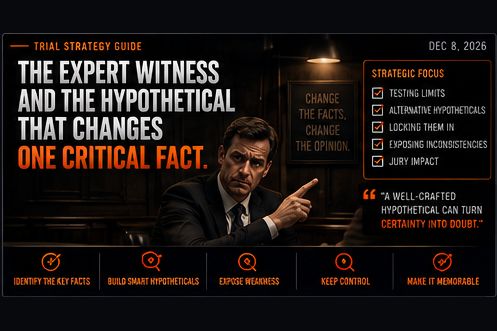
The problem hiding in plain sight
A good hypothetical does not need theatrics. It needs one altered assumption. Experts frequently practice defending their conclusion but rarely practice explaining where that conclusion stops being valid.
Where to look first
Build an assumption ledger: each important premise, its source, and whether it is established, disputed, inferred, or assumed. Change one fact at a time, using plausible alternatives from the record.
The rehearsal that matters
Ask whether the conclusion changes, what additional information is needed, and whether the question reaches beyond the expert’s discipline. Watch for reflexive refusal to engage and equally reflexive certainty about work never performed.
The rule and the practical limit
“I would need to analyze that” may be the most reliable answer in the room. A courtroom is an expensive place to improvise sensitivity analysis.
A practical exercise for the next prep session
Before ending the meeting, have a second examiner ask five questions the witness has not seen. Include one inaccurate premise, one inconvenient document, one legitimate uncertainty, one follow-up that changes a fact, and one long silence. Record which answers require additional investigation. Correct the underlying preparation, not merely the wording of the answer.
What to take into the room
The goal is not to manufacture a perfect witness. It is to uncover uncertainty early, clarify what the evidence actually supports, and help a truthful witness remain accurate when questioning gets uncomfortable. Third Degree can support simulated questioning; attorney judgment and factual investigation remain essential.
Change one fact, not the entire universe
An effective expert hypothetical isolates a premise that matters to the opinion. If the expert assumed a vehicle speed of 55 mph, ask what happens at 45 mph. If the physician assumed a particular onset date, change the date. The examiner should know why the variable matters and whether the expert can quantify its effect. Hypotheticals are useful for exposing conditional reasoning, not for demanding that a witness endorse facts outside the record.
A preparation drill you can actually run
In rehearsal, use a ladder: confirm the original assumption, substitute one supported alternative, ask whether the opinion changes, and request the reason. Then introduce a second fact only after the first is resolved. Teach the expert to distinguish accepting a hypothetical for purposes of analysis from agreeing that it happened. “I would need to calculate that” can be an accurate answer; making up a number is not.
What the opposing examiner will ask next
A prepared examiner rarely stops at the first answer. They ask how the witness knows, which record supports it, what contrary material exists, and whether the answer would change if a key premise proves false. Practice that sequence with the real file, not a hypothetical universe where every document supports your side. Identify the questions the team cannot yet answer and assign investigation before the testimony.
The distinction matters: rehearsal is a method for discovering weaknesses and helping a witness testify accurately. It is not an invitation to invent facts, conceal documents, or polish an unsupported story. Counsel should evaluate local rules, case orders, privilege, and the actual evidentiary record before applying any technique.
A 20-minute partner-level review
Give a lawyer who did not draft the outline twenty minutes with the file. Ask for the three most uncomfortable questions, the most damaging exhibit, and the one answer that would trigger follow-up discovery. Have that lawyer question the witness without warning. Then discuss where the witness relied on firsthand knowledge, reviewed records, or assumptions. Repeat after genuine factual gaps are addressed.
The final check is simple: can the witness explain what they know, how they know it, and what they do not know without pretending? That is a far more valuable outcome than an impressive practice score.
Field guide: Change one fact, not the entire universe
A carefully constructed hypothetical tests which facts actually drive an expert opinion. Start with the facts the expert accepts, then change one assumption: a reaction time, an exposure level, a sample size, or a mechanism of injury. Ask whether the opinion survives and why. Do not mix six changes together; if the conclusion moves, nobody will know which variable mattered.
Put it to work
Build a sensitivity sheet with the original assumption, changed value, reason for the change, and the expert’s response. Ask what evidence would resolve the uncertainty. The expert should identify when a hypothetical lacks adequate foundation and avoid adopting false premises as established facts. Good preparation teaches the witness to explain the boundary of an opinion, not to defend the same conclusion regardless of the record. The latter is an impressive demonstration of flexibility, just not the kind Rule 702 rewards.
Legal source: Federal Rule of Evidence 702 (Cornell LII)
Federal-law discussion is general; jurisdiction, local rules, and case orders may alter the analysis.
Don't Get Trapped by Loaded Cross-Examination Hypotheticals.
Opposing trial counsel loves leading questions with tweaked variables designed to bait you into contradictory admissions. Rehearse defending your conclusions against an adversarial AI examiner trained on courtroom cross tactics.
Real-time voice sparring · Deception-risk scoring · Zero Data Retention