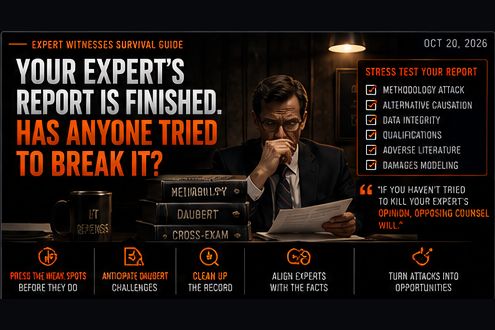
The problem hiding in plain sight
The expert signed the report. Everyone celebrated. Meanwhile, a footnote relies on an assumption nobody tested. Opposing counsel will eventually find it, usually after enlarging the relevant exhibit to a size normally reserved for billboards.
Where to look first
For every important conclusion, trace the source data, method, inference, and limitation. Have a second lawyer conduct a source audit without asking the report’s drafter what it was supposed to mean. Does each citation support the actual proposition? What happens if a key input moves?
The rehearsal that matters
A productive mock examination changes assumptions one at a time. Ask what the expert did not review, what alternative explanation was considered, and which conclusions fall outside the analysis. A measured concession is often more credible than an answer invented to rescue the report.
The rule and the practical limit
Federal Rule 26 controls expert disclosures and supplementation. Before rewriting an opinion, check deadlines and disclosure consequences. The goal of a stress test is not a prettier document; it is finding weaknesses while the team can still do something about them.
A practical exercise for the next prep session
Before ending the meeting, have a second examiner ask five questions the witness has not seen. Include one inaccurate premise, one inconvenient document, one legitimate uncertainty, one follow-up that changes a fact, and one long silence. Record which answers require additional investigation. Correct the underlying preparation, not merely the wording of the answer.
What to take into the room
The goal is not to manufacture a perfect witness. It is to uncover uncertainty early, clarify what the evidence actually supports, and help a truthful witness remain accurate when questioning gets uncomfortable. Third Degree can support simulated questioning; attorney judgment and factual investigation remain essential.
Treat the report as a collection of attackable commitments
For each conclusion, trace the factual assumptions, supporting exhibits, method, alternative explanations, and limitations. Mark every phrase that claims causation, certainty, or exclusion of competing causes. Then change one input. If the timestamp moves, if a patient history is inaccurate, if a control group disappears, what changes? The point is not to force an expert to defend the indefensible. It is to learn exactly where the opinion holds and where it stops.
A preparation drill you can actually run
Ask the expert to explain the methodology without reading the report. Introduce a contradictory record, a prior publication, and a hypothetical with one altered fact. Require the expert to distinguish between what they personally did and what staff performed. Document new opinions that may require disclosure analysis under Rule 26; do not disguise substantive changes as mere clarification. A beautiful chart is not a substitute for a reliable inference.
What the opposing examiner will ask next
A prepared examiner rarely stops at the first answer. They ask how the witness knows, which record supports it, what contrary material exists, and whether the answer would change if a key premise proves false. Practice that sequence with the real file, not a hypothetical universe where every document supports your side. Identify the questions the team cannot yet answer and assign investigation before the testimony.
The distinction matters: rehearsal is a method for discovering weaknesses and helping a witness testify accurately. It is not an invitation to invent facts, conceal documents, or polish an unsupported story. Counsel should evaluate local rules, case orders, privilege, and the actual evidentiary record before applying any technique.
A 20-minute partner-level review
Give a lawyer who did not draft the outline twenty minutes with the file. Ask for the three most uncomfortable questions, the most damaging exhibit, and the one answer that would trigger follow-up discovery. Have that lawyer question the witness without warning. Then discuss where the witness relied on firsthand knowledge, reviewed records, or assumptions. Repeat after genuine factual gaps are addressed.
The final check is simple: can the witness explain what they know, how they know it, and what they do not know without pretending? That is a far more valuable outcome than an impressive practice score.
Field guide: The opinion-by-opinion stress test
Build a table for each material opinion: conclusion, supporting data, assumptions, method, contrary evidence, and limits. For an engineering report blaming a product defect, ask what inspection established the failure origin, which alternative causes were examined, and what would change if a disputed measurement were wrong. Have someone uninvolved in drafting the report conduct the first hostile review. The most useful challenge is often a quiet “Where is that number?” rather than a dramatic accusation of bias.
Put it to work
Change one factual premise at a time: the timestamp, a comparator, a missing maintenance record, or the condition of a sample. Ask the expert whether the opinion remains unchanged, narrows, requires more analysis, or cannot be supported. Record the explanation. If the drill exposes missing work, address the analysis and any required supplementation—not merely the delivery. An expert who identifies the real limits of an opinion is more useful than one who insists every imaginable fact leads to the same conclusion.
Legal source: Federal Rule of Civil Procedure 26 (Cornell LII)
Federal-law discussion is general; jurisdiction, local rules, and case orders may alter the analysis.
Pressure-Test Your Expert Report Before Opposing Counsel Reads It.
Opposing counsel will spend weeks dissecting your Rule 26 disclosures line by line. Upload your report to our Expert Witness room and face an AI cross-examiner designed to attack your data sources, probe missing controls, and challenge your conclusions under oath.
Supports multi-page PDF & OCR document uploads · Real-time voice interaction · Zero Data Retention