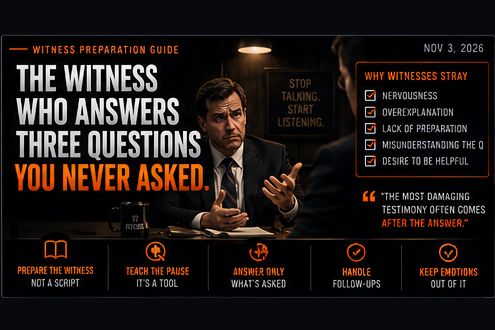
The problem hiding in plain sight
The first answer was correct. The next forty seconds were opposing counsel’s birthday present. Witnesses frequently volunteer background because they want to seem cooperative, complete, and reasonable. That instinct is understandable. It can also create three new lines of questioning.
Where to look first
Teach proportionality, not robotic brevity. Some questions need context; a misleading yes or no is not an acceptable goal. A witness should answer accurately, address a false premise, explain when necessary, and stop when the answer is complete.
The rehearsal that matters
Try the silence drill: ask a straightforward question, accept the answer, and wait three seconds. Then add compound questions and accusations that provoke defensiveness. Score accuracy and responsiveness, not fewest words.
The rule and the practical limit
A witness who can tolerate silence is harder to derail. Opposing counsel is entitled to truthful answers, not an unsolicited autobiography.
A practical exercise for the next prep session
Before ending the meeting, have a second examiner ask five questions the witness has not seen. Include one inaccurate premise, one inconvenient document, one legitimate uncertainty, one follow-up that changes a fact, and one long silence. Record which answers require additional investigation. Correct the underlying preparation, not merely the wording of the answer.
What to take into the room
The goal is not to manufacture a perfect witness. It is to uncover uncertainty early, clarify what the evidence actually supports, and help a truthful witness remain accurate when questioning gets uncomfortable. Third Degree can support simulated questioning; attorney judgment and factual investigation remain essential.
The five-second silence test
Ask a narrow question, wait for the answer, and then say nothing for five seconds. Watch how often the witness volunteers a new person, date, document, or motive. The pause does not require another sentence. Repeat with an inaccurate premise, a compound question, and an unfamiliar exhibit. Teach witnesses to ask for clarification when necessary and to qualify an answer when a bare yes or no would mislead. Brevity is useful only when it remains truthful.
A preparation drill you can actually run
Separate factual investigation from deposition rehearsal. The first benefits from broad storytelling; the second requires accurate responses to narrow, sometimes hostile questions. Count unnecessary additions per ten answers, speculative statements, and uncorrected false premises. Do not train a witness to repeat “I do not recall” when they actually remember. The goal is truthful precision, not tactical amnesia.
What the opposing examiner will ask next
A prepared examiner rarely stops at the first answer. They ask how the witness knows, which record supports it, what contrary material exists, and whether the answer would change if a key premise proves false. Practice that sequence with the real file, not a hypothetical universe where every document supports your side. Identify the questions the team cannot yet answer and assign investigation before the testimony.
The distinction matters: rehearsal is a method for discovering weaknesses and helping a witness testify accurately. It is not an invitation to invent facts, conceal documents, or polish an unsupported story. Counsel should evaluate local rules, case orders, privilege, and the actual evidentiary record before applying any technique.
A 20-minute partner-level review
Give a lawyer who did not draft the outline twenty minutes with the file. Ask for the three most uncomfortable questions, the most damaging exhibit, and the one answer that would trigger follow-up discovery. Have that lawyer question the witness without warning. Then discuss where the witness relied on firsthand knowledge, reviewed records, or assumptions. Repeat after genuine factual gaps are addressed.
The final check is simple: can the witness explain what they know, how they know it, and what they do not know without pretending? That is a far more valuable outcome than an impressive practice score.
Field guide: Silence is not a follow-up question
A witness asked whether an inspection occurred Tuesday answers yes, then volunteers that the Friday inspection was delayed because staffing had been short for months. The question concerned Tuesday. The answer introduced a new discovery project. The solution is not to demand yes-or-no answers to every question; some questions contain false premises or require qualification to be truthful. Train witnesses to identify the question, answer accurately within its scope, and stop when the answer is complete.
Put it to work
Run a five-second silence drill after each answer. Watch whether the witness fills the gap with unnecessary material. Next, introduce a false-premise question and reward an accurate correction rather than mechanical agreement. Finally, show a contradictory document and ask whether it changes the answer. Score accuracy, resistance to speculation, and honest uncertainty—not minimum word count. Opposing counsel can ask the next question. They usually do.
Legal source: Federal Rule of Civil Procedure 30 (Cornell LII)
Federal-law discussion is general; jurisdiction, local rules, and case orders may alter the analysis.
Stop Volunteering Testimony. Train Your Narrow Answer Reflex.
Overexplaining is the most expensive mistake in civil litigation. In our simulated Deposition Room, practice answering hostile opposing counsel who exploits rambling answers, locks in commitments, and scores your precision sentence by sentence.
Includes document OCR case-file uploads · Zero Data Retention guarantee · Built for litigation teams