The problem hiding in plain sight
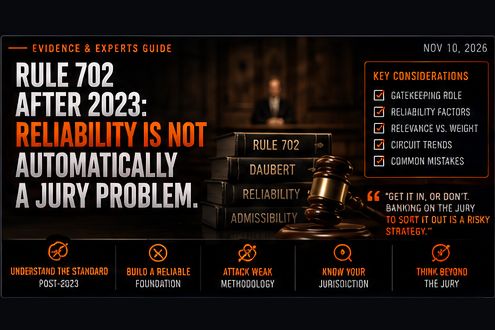
The amended Rule 702 clarifies that the proponent must establish admissibility requirements by a preponderance of the evidence. Sufficiency of the basis and reliable application are not automatically jury-weight questions.
Where to look first
Make a four-column map: data, principles and methods, application, and conclusion. Then identify the inferential leaps. An impressive CV does not substitute for reliable application to the facts of this case.
The rehearsal that matters
In a rehearsal, change a factual premise and ask the expert to explain whether the opinion changes. A principled “I would need to analyze that” is preferable to a confident calculation invented on the record.
The rule and the practical limit
Read the 2023 committee notes before reflexively declaring that every methodological criticism “goes to weight.” That phrase is not a universal solvent.
A practical exercise for the next prep session
Before ending the meeting, have a second examiner ask five questions the witness has not seen. Include one inaccurate premise, one inconvenient document, one legitimate uncertainty, one follow-up that changes a fact, and one long silence. Record which answers require additional investigation. Correct the underlying preparation, not merely the wording of the answer.
What to take into the room
The goal is not to manufacture a perfect witness. It is to uncover uncertainty early, clarify what the evidence actually supports, and help a truthful witness remain accurate when questioning gets uncomfortable. Third Degree can support simulated questioning; attorney judgment and factual investigation remain essential.
Show the path from data to opinion
The 2023 amendment to Federal Rule of Evidence 702 clarifies that the proponent must show the admissibility requirements are more likely than not satisfied. “It goes to weight” cannot resolve every challenge to the sufficiency of the basis or reliability of application. Have the expert identify the data, method, judgment calls, validation, uncertainty, and inferential steps. An expert who says “I considered everything” has explained almost nothing.
A preparation drill you can actually run
Run three rounds: teach the method in plain language; change a material assumption; confront a credible alternative explanation. Ask what observation would weaken the opinion. Distinguish true admissibility objections from factual disputes appropriately tested on cross. The amendment does not make every methodological disagreement fatal; it does demand a serious threshold analysis rather than a slogan.
What the opposing examiner will ask next
A prepared examiner rarely stops at the first answer. They ask how the witness knows, which record supports it, what contrary material exists, and whether the answer would change if a key premise proves false. Practice that sequence with the real file, not a hypothetical universe where every document supports your side. Identify the questions the team cannot yet answer and assign investigation before the testimony.
The distinction matters: rehearsal is a method for discovering weaknesses and helping a witness testify accurately. It is not an invitation to invent facts, conceal documents, or polish an unsupported story. Counsel should evaluate local rules, case orders, privilege, and the actual evidentiary record before applying any technique.
A 20-minute partner-level review
Give a lawyer who did not draft the outline twenty minutes with the file. Ask for the three most uncomfortable questions, the most damaging exhibit, and the one answer that would trigger follow-up discovery. Have that lawyer question the witness without warning. Then discuss where the witness relied on firsthand knowledge, reviewed records, or assumptions. Repeat after genuine factual gaps are addressed.
The final check is simple: can the witness explain what they know, how they know it, and what they do not know without pretending? That is a far more valuable outcome than an impressive practice score.
Field guide: Find the unsupported step
The 2023 amendment to Federal Rule of Evidence 702 clarified that the proponent must establish admissibility requirements by a preponderance of the evidence, including reliable application of a reliable method to the facts. A credentialed engineer may use an accepted technique yet rely on an unverified loading assumption or a photograph that cannot show the claimed failure origin. Credentials and methodology labels do not resolve application.
Put it to work
Draw a chain from each conclusion to the inputs, method, and factual record. Ask what happens if the weakest input is excluded. A mock examiner should press on missing measurements, alternative explanations, and the actual limits of the technique. For a motion, identify the specific unreliable step rather than reciting a generic Daubert checklist. For the proponent, show how the method fits this record. An opinion does not become reliable merely because it is delivered with a very expensive résumé.
Legal source: Federal Rule of Evidence 702 (Cornell LII)
Federal-law discussion is general; jurisdiction, local rules, and case orders may alter the analysis.
Stress-Test Your Expert Report Against Rule 702 Challenges.
Under the amended Rule 702, the proponent must demonstrate admissibility by a preponderance of the evidence. Step into our Expert Witness room and subject your methodology, data sources, and qualifications to rigorous adversarial examination before your Daubert hearing.
Supports report and affidavit uploads · Relentless adversarial cross · Zero Data Retention guarantee