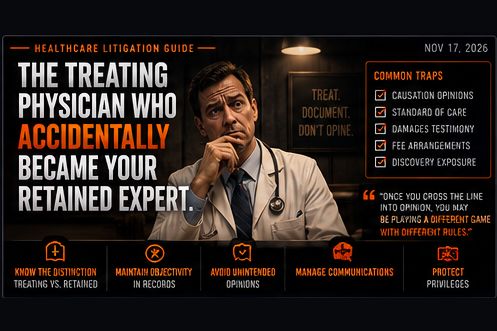
The problem hiding in plain sight
“The doctor treated the patient” is not the end of the expert-disclosure analysis. The origin and scope of the opinions matter. A causation theory developed after counsel supplied a litigation binder may raise different disclosure questions than observations made during treatment.
Where to look first
Inventory every anticipated opinion: diagnosis, prognosis, causation, permanency, future care, and alternatives. Record when it was formed and which records support it. Compare the medical chart to what counsel hopes the physician will say.
The rehearsal that matters
Rehearse questions about prior conditions, treatment gaps, competing explanations, and what the physician actually documented. If the physician is discovering a new opinion during the mock deposition, counsel should review the disclosure plan.
The rule and the practical limit
Rule 26(a)(2) distinguishes witnesses subject to written-report requirements from those subject to summary disclosure. Check jurisdiction-specific decisions before treating a physician’s job title as an exemption.
A practical exercise for the next prep session
Before ending the meeting, have a second examiner ask five questions the witness has not seen. Include one inaccurate premise, one inconvenient document, one legitimate uncertainty, one follow-up that changes a fact, and one long silence. Record which answers require additional investigation. Correct the underlying preparation, not merely the wording of the answer.
What to take into the room
The goal is not to manufacture a perfect witness. It is to uncover uncertainty early, clarify what the evidence actually supports, and help a truthful witness remain accurate when questioning gets uncomfortable. Third Degree can support simulated questioning; attorney judgment and factual investigation remain essential.
Treatment opinion versus litigation opinion
A treating physician may testify about observations and opinions formed during care, but the disclosure obligations depend on the opinions offered and the witness’s role. Under Rule 26(a)(2), a retained or specially employed expert generally has different reporting obligations from a non-retained witness, who may still require a subject-matter and opinion summary. Courts differ on boundary questions. Asking a treating physician to perform a fresh litigation-specific causation analysis can change the disclosure picture.
A preparation drill you can actually run
Compare the medical record with the proposed testimony. For each opinion, identify when it was formed, what information was available, and whether it arose from treatment or later attorney-directed analysis. Rehearse questions about outside records, differential diagnosis, and facts learned only after litigation began. Do not assume the white coat answers the disclosure question; it does not.
What the opposing examiner will ask next
A prepared examiner rarely stops at the first answer. They ask how the witness knows, which record supports it, what contrary material exists, and whether the answer would change if a key premise proves false. Practice that sequence with the real file, not a hypothetical universe where every document supports your side. Identify the questions the team cannot yet answer and assign investigation before the testimony.
The distinction matters: rehearsal is a method for discovering weaknesses and helping a witness testify accurately. It is not an invitation to invent facts, conceal documents, or polish an unsupported story. Counsel should evaluate local rules, case orders, privilege, and the actual evidentiary record before applying any technique.
A 20-minute partner-level review
Give a lawyer who did not draft the outline twenty minutes with the file. Ask for the three most uncomfortable questions, the most damaging exhibit, and the one answer that would trigger follow-up discovery. Have that lawyer question the witness without warning. Then discuss where the witness relied on firsthand knowledge, reviewed records, or assumptions. Repeat after genuine factual gaps are addressed.
The final check is simple: can the witness explain what they know, how they know it, and what they do not know without pretending? That is a far more valuable outcome than an impressive practice score.
Field guide: When was the opinion actually formed?
A surgeon documents neurological deficits during treatment. Months later, counsel sends accident reconstruction materials and asks the surgeon to opine on crash mechanics. Those may be different kinds of opinions. Rule 26(a)(2)(C) addresses disclosures for certain non-reporting expert witnesses; Rule 26(a)(2)(B) governs specified reporting experts. Whether a treating clinician needs a report depends on the opinions, their origins, and governing precedent—not the label “treating physician.”
Put it to work
Interview the physician opinion by opinion: when was it formed, what information was available, where was it documented, and what later materials were considered? Rehearse questions separating treatment observations from litigation-generated analysis. Check disclosure deadlines, local rules, and circuit precedent. Medical records are not invariably a complete expert disclosure, and treating physicians do not invariably need retained-expert reports. The useful work is drawing the correct boundary before the deposition.
Legal source: Federal Rule of Civil Procedure 26 (Cornell LII)
Federal-law discussion is general; jurisdiction, local rules, and case orders may alter the analysis.
Hold the Line Between Clinical Treatment and Expert Causation.
Opposing counsel will push treating physicians past their treatment notes into speculative causation opinions that trigger exclusion. Practice staying firmly within your clinical scope across from an aggressive AI questioner.
Medical records OCR upload · Real-time voice simulation · Zero Data Retention