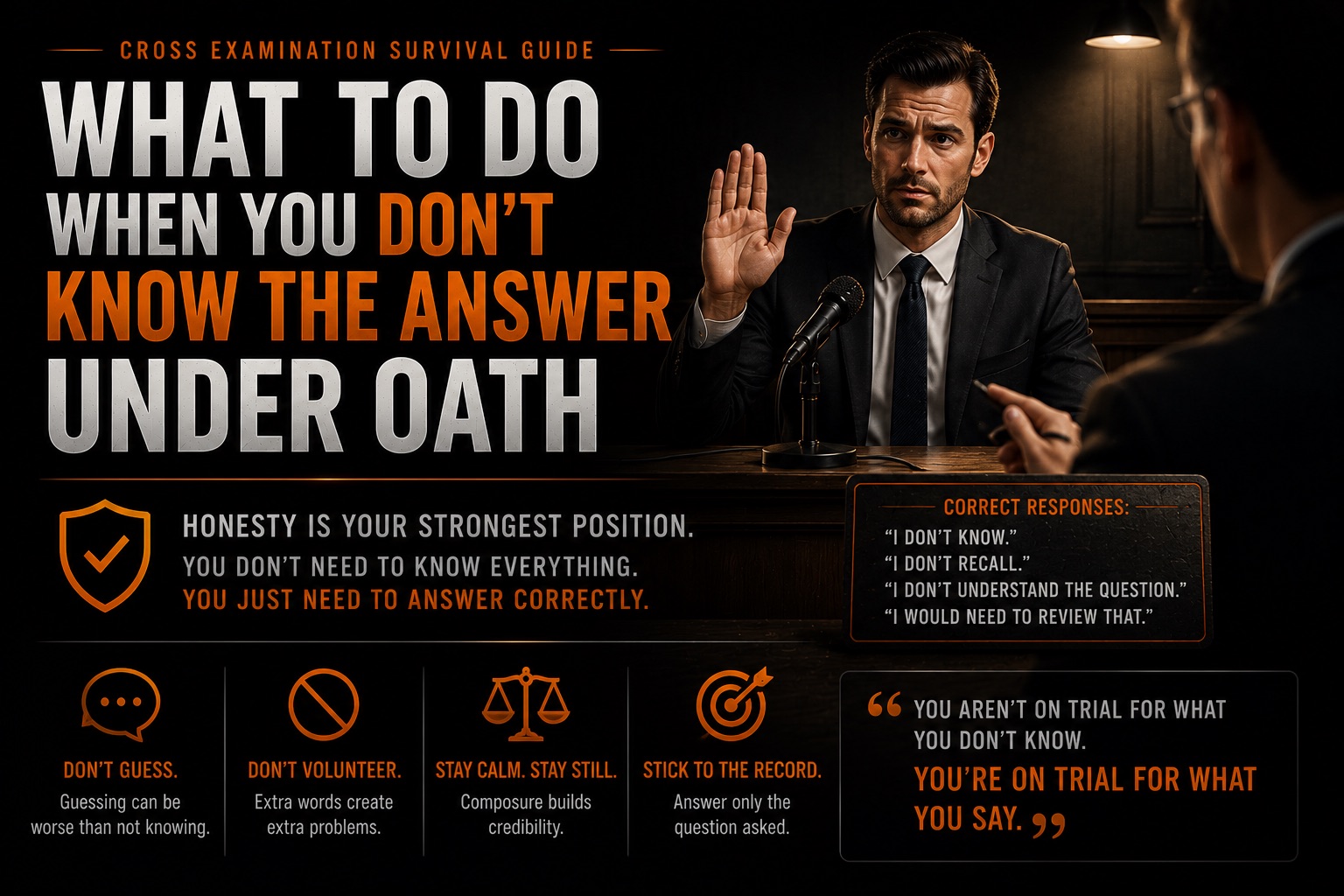
In a deposition, the most dangerous moment isn't the question you can't answer — it's the silence right after it. Opposing counsel asks something you genuinely don't know, a beat passes, and the instinct to fill that silence takes over. That instinct is where witnesses get taken apart.
"I don't know" is a complete answer
You are not there to be helpful. You're there to answer truthfully — and sometimes the truth is that you don't know. That's a full, legitimate, unimpeachable answer. It closes the door. A guess opens ten new ones, and every one of them is now on the record with your name on it.
Know the difference: "I don't know" vs. "I don't recall"
They are not interchangeable, and a sharp examiner will punish the wrong one:
- "I don't know" — you never had the information.
- "I don't recall" — you may have known it once, but you don't remember now.
Say "I don't recall" about something you plainly should know and you invite impeachment — "You don't recall your own job title?" Say "I don't know" about something you clearly witnessed and you sound evasive. Reach for the one that's actually true.
Never speculate
"I'm not sure, but I'd guess…" is the phrase that ends careers on the record. A guess, once transcribed, becomes testimony — and it can be read back to you months later as though you'd said it with certainty. If you don't know, stop at "I don't know." Don't estimate, don't theorize, don't help them build the timeline.
The witness who says "I don't know" three times in a row and means it is far stronger than the one who guesses once.
Say it without looking cagey
The fear is that "I don't know" sounds like you're hiding something. It doesn't — rambling does. Deliver it plainly, drop the qualifiers, and hold the pause. If you want a truthful boundary, add one: "I don't know that. I'd be guessing." That reads as careful, not cornered.
The only way to get good at it is reps
Knowing this intellectually and doing it while a hostile examiner bears down on you are two different skills. Under real pressure the silence feels unbearable and the guess feels like relief. You retrain that reflex the only way anyone does — by sitting in the chair, again and again, until "I don't know" comes out steady instead of scared. That's exactly what The Third Degree is built for.
Practice the pressure.
Sit across from an AI examiner that won't let you ramble — and learn to hold the line for real.
Launch the Web App